Billing Dispute Guide
Billing Dispute Complaint Help
Billing disputes can be stressful, especially when a company keeps charging you, refuses to correct an error, ignores your complaint, or gives you unclear answers. Whether the issue involves a subscription, service provider, travel company, merchant, repair shop, telecom company, online platform, or other business, a billing dispute needs to be handled carefully and professionally.
At Consumer Escalation Services, we help consumers organize billing complaints, prepare documentation, and escalate unresolved billing disputes through structured, nonlegal consumer advocacy support.
📞 Call 1 (855) 444-4177 or visit ConsumerEscalationServices.com to request help.
Definition
What Is a Billing Dispute?
A billing dispute happens when you believe a charge, fee, invoice, subscription, account balance, or payment demand is wrong, unauthorized, unfair, unexplained, or not consistent with what you agreed to.
Common billing disputes include:
- Unauthorized charges
- Duplicate charges
- Subscription charges after cancellation
- Incorrect invoices
- Overcharges
- Hidden fees
- Charges for services not received
- Refund not applied
- Account credit not posted
- Cancellation not honored
- Merchant billing errors
- Service provider billing disputes
Billing problems can become more serious when the company refuses to explain the charge or keeps transferring you between departments.
Evidence
Why Billing Disputes Need Documentation
A billing dispute is stronger when you can show what happened.
Documentation may include:
- Billing statements
- Receipts
- Invoices
- Subscription confirmations
- Cancellation confirmations
- Emails
- Screenshots
- Account history
- Chat transcripts
- Bank or card statements
- Terms of service
- Written promises from the company
- Case numbers
The more organized your documents are, the easier it becomes to explain the dispute.
Avoid these
Common Billing Dispute Mistakes
Many consumers hurt their own billing dispute by reacting emotionally or failing to keep records.
Common mistakes include:
- Calling repeatedly without creating a written record
- Not saving cancellation confirmations
- Not taking screenshots of account pages
- Disputing the charge without explaining the facts
- Sending vague emails
- Missing important deadlines
- Not asking for written confirmation
- Not requesting escalation
- Accepting verbal promises without follow up
- Failing to track dates and names
A strong billing complaint should be organized, factual, and specific.
Step by step
How to Handle a Billing Dispute
Identify the Exact Charge
Start by identifying the specific charge or invoice being disputed. Include:
- Date of charge
- Amount charged
- Company name
- Account number if applicable
- Invoice number if applicable
- Payment method
- Reason you believe the charge is wrong
Do not generalize. Be precise.
Gather Billing Records
Collect all billing related documents. This may include:
- Statements
- Invoices
- Receipts
- Account history
- Subscription terms
- Emails
- Cancellation notices
- Chat transcripts
- Screenshots
Keep everything in one organized file or folder.
Create a Billing Timeline
Your timeline should show the history of the issue. Include:
- When the account or service started
- When the disputed charge appeared
- When you contacted the company
- Who responded
- What was promised
- Whether the issue was corrected
- Any follow up attempts
A billing timeline helps show that the problem is unresolved.
Contact the Company in Writing
Whenever possible, communicate in writing. Your message should include:
- The disputed charge
- Why you dispute it
- What documentation supports your position
- What resolution you are requesting
- A request for written confirmation
A written complaint gives you a record.
Ask for Escalation
If customer service does not resolve the issue, request escalation. Example language: "Please escalate this billing dispute to a supervisor, billing resolution department, executive support team, or other department authorized to review unresolved billing complaints."
This makes your request more formal and focused.
Keep Following Up
A billing dispute may require more than one communication. Track each follow up:
- Date sent
- Person contacted
- Response received
- Promised action
- Next step
Do not let the company control the timeline without documentation.
Our support
How Consumer Escalation Services Can Help With Billing Disputes
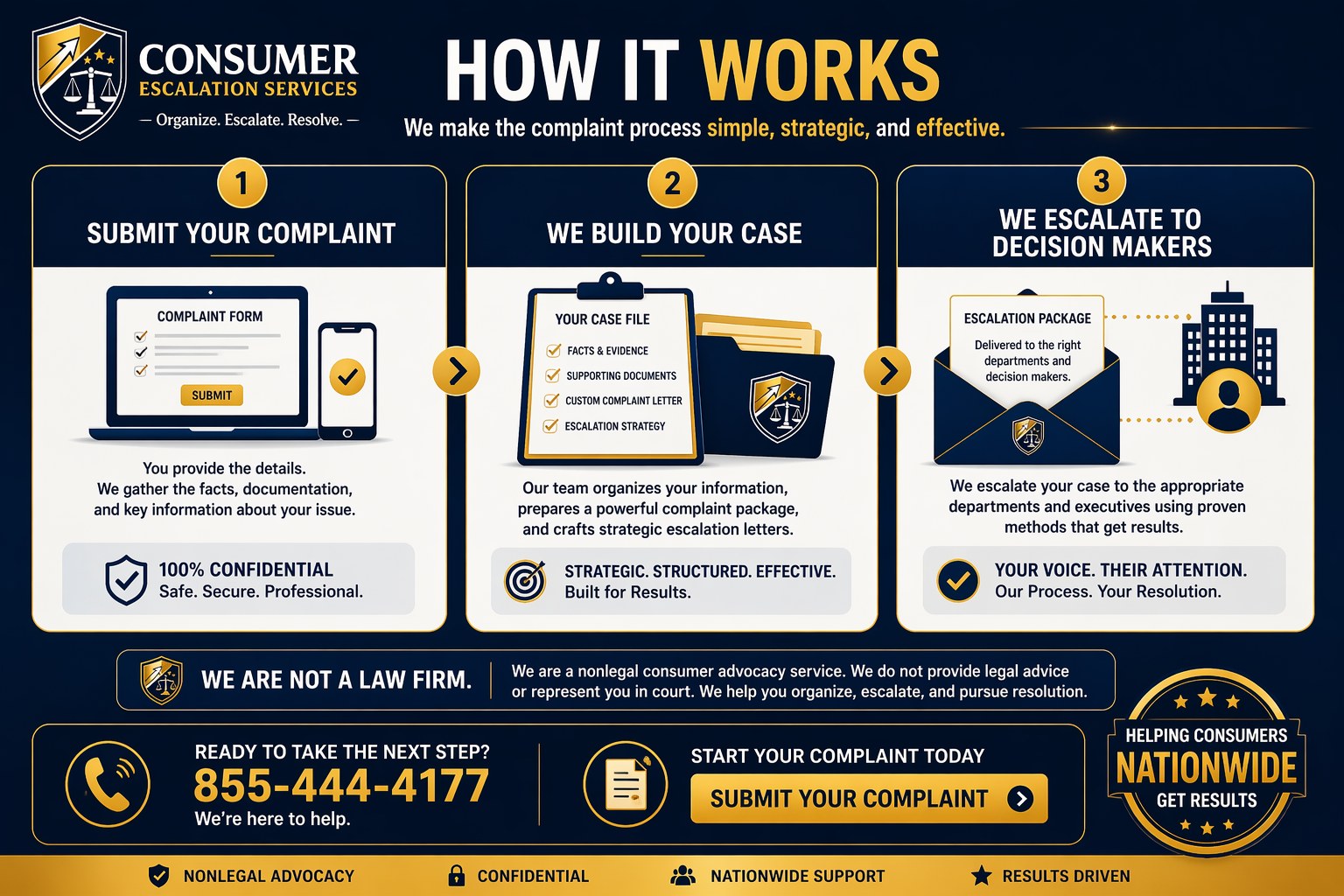
Consumer Escalation Services can help you organize and present your billing dispute more professionally. Our support may include:
- Billing dispute review
- Timeline preparation
- Evidence organization
- Complaint letter drafting
- Billing escalation letter preparation
- Executive escalation package preparation
- Follow up message support
- Consumer documentation support
We help you explain the dispute clearly, organize supporting records, and prepare a stronger escalation package.
Examples
Examples of Billing Disputes CES May Assist With
Consumer Escalation Services may assist with billing disputes involving:
- Subscription services
- Online platforms
- Travel companies
- Hotels
- Airlines
- Auto repair shops
- Service providers
- Phone and internet companies
- Merchants
- Membership companies
- Event companies
- Small business vendor disputes
Every case is different, and results depend on the facts, documentation, company policies, timing, and other factors.
Also Dealing With an Automated Denial?
When the system says no, CES helps you escalate back to a human.
Some consumer complaints are now handled by AI chatbots, automated refund systems, fraud filters, and no-human-review customer-service workflows. If your issue was denied by an automated system or you cannot reach a real person, CES may be able to help you organize the facts and prepare a structured escalation request.
Learn About Algorithmic Escalation Support for Automated Billing SystemsFAQ
Frequently Asked Questions
Keep Reading
Related Consumer Resources
More guidance to help you organize, escalate, and resolve consumer complaints.
How to Escalate a Consumer Complaint Professionally
Read guide
Refund Dispute Support Service
Read guide
How to Write a Strong Complaint Letter
Read guide
General Contractor Disputes
Read guide
How to Dispute a Medical Bill Sent to Collections
Read guide
Rideshare and Delivery App Deactivation Complaints
Read guide
Consumer Complaint Help Center
Read guide
Consumer Escalation Services is not a law firm, does not provide legal advice, does not represent clients in court, and does not guarantee outcomes, refunds, reimbursements, settlements, or resolutions. Services are for educational, organizational, documentation, and nonlegal consumer advocacy support purposes only.