
Free Consumer Resource Guide
How to Dispute a Medical Bill Sent to Collections
A step-by-step consumer guide to organizing your medical bills, reviewing insurance documents, requesting verification, and escalating billing problems before you panic, pay blindly, or ignore the notice.
Receiving a collection notice for a medical bill can be stressful, especially when you believe insurance should have paid, the amount looks wrong, or you never received a clear explanation. This guide explains how to slow the process down, organize your documents, and take structured steps to dispute or escalate the issue.
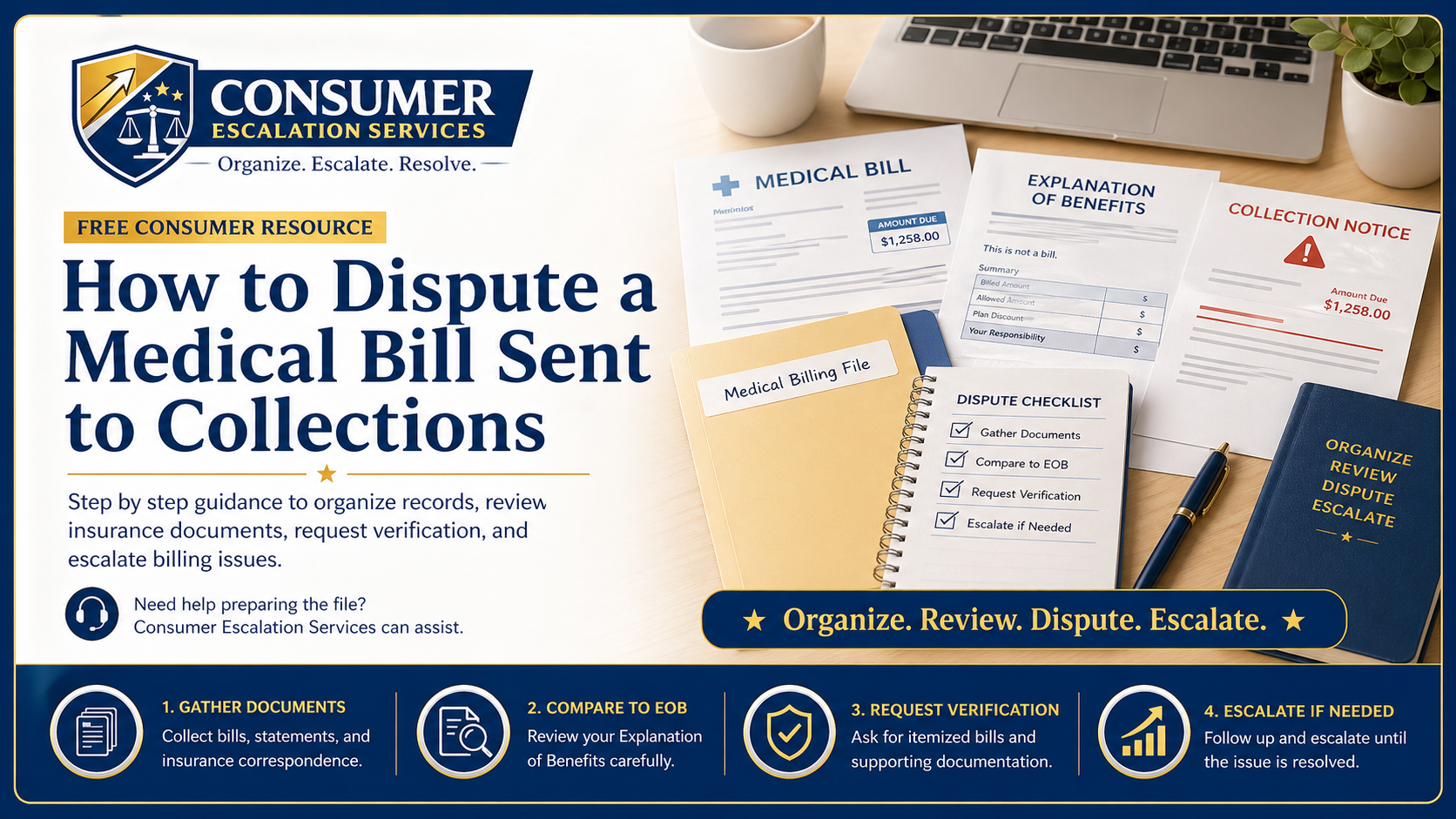
First, Do Not Panic and Do Not Ignore It
A medical collection notice does not automatically mean the amount is correct, properly billed, or fully owed exactly as stated. Medical bills can involve provider billing errors, insurance processing issues, duplicate charges, missing documentation, surprise billing concerns, or unclear balances.
Before responding, try to confirm:
- Who is collecting the bill
- Who the original medical provider was
- The date of service
- The amount claimed
- Whether insurance was billed
- Whether you received an Explanation of Benefits
- Whether the bill appears on your credit report
- Whether you already paid any part of it
- Whether you ever received an itemized bill
Gather Every Document Connected to the Bill
Start by building a basic file. Do not rely only on memory. Medical bill disputes are easier to explain when the documents are organized.
- Collection notice
- Original medical bill
- Itemized bill if available
- Insurance Explanation of Benefits
- Insurance denial letter if applicable
- Payment receipts
- Provider portal messages
- Emails or letters from the provider
- Emails or letters from the insurance company
- Notes from phone calls
- Dates of service
- Provider name
- Hospital or clinic name
- Insurance company name
- Collection agency name
- Credit report screenshot if the collection appears on a credit report
Compare the Medical Bill to the Insurance Explanation of Benefits
An Explanation of Benefits, often called an EOB, is not the same as a bill. It usually shows what the provider charged, what the insurance company allowed, what insurance paid, what was denied, and what the patient may owe.
- The same date of service
- The same provider name
- The same procedure or service
- The billed amount
- The allowed amount
- Insurance payments
- Patient responsibility
- Denial codes or reason codes
- Whether the provider balance matches the EOB
If the provider bill does not match the EOB, that may be a reason to request clarification before paying or accepting the collection balance.
Request an Itemized Bill From the Provider
If the bill is unclear, ask the provider or hospital billing office for an itemized bill. This can help identify duplicate charges, services you do not recognize, coding issues, or balances that were not clearly explained.
Suggested language
Please provide an itemized statement for this account showing the date of service, provider, procedure codes or service descriptions, original charges, insurance payments, contractual adjustments, patient payments, remaining balance, and any collection referral date.
Ask Whether Insurance Was Properly Billed
If you had insurance at the time of service, contact both the provider and the insurance company. Ask whether the claim was submitted, whether it was accepted or denied, and whether any missing information caused a denial.
Questions to ask the provider:
- Was my insurance billed?
- What date was the claim submitted?
- Was the claim denied?
- What was the denial reason?
- Was any corrected claim submitted?
- Was I sent notices before this went to collections?
Questions to ask the insurance company:
- Did you receive this claim?
- Was the claim processed?
- Was it denied?
- What was the denial reason?
- Was the provider in network or out of network?
- What amount is listed as patient responsibility?
- Can the claim be reprocessed or appealed?
Need help preparing your dispute file?
CES can organize your medical bills, Explanation of Benefits, collection notices, and correspondence into a clear nonlegal dispute and escalation package.
Request Debt Verification or Clarification From the Collection Agency
If a collection agency is contacting you, you can request information showing what the debt is, who the original creditor was, and why the amount is being collected. Keep your request calm, written, and factual.
Suggested language
I am requesting verification and clarification of this medical debt. Please provide the name of the original provider, date of service, account number, itemized balance, insurance payments or adjustments applied, patient responsibility amount, and documentation showing why this amount is being collected.
Note: Do not admit responsibility for a balance you do not understand. Ask for documentation first.
Dispute the Bill in Writing if Something Appears Wrong
If the amount appears incorrect, insurance may not have been processed correctly, the provider bill does not match the EOB, or the bill was sent to collections before you received proper explanation, prepare a written dispute.
- Your name and contact information
- Account number if available
- Date of service
- Provider name
- Collection agency name if applicable
- Clear explanation of what you dispute
- List of documents attached
- Specific request for review, correction, itemization, insurance reprocessing, or pause in collection activity while reviewed
- Request for written response
Escalate to the Provider or Hospital Billing Department
If front-line billing representatives cannot resolve the issue, escalate politely to a supervisor, patient financial services, patient relations, or the hospital patient advocate.
Escalation request
I am requesting a supervisory review of this account because the bill appears unresolved, unclear, or potentially connected to insurance processing issues. Please review the account, confirm whether insurance was properly billed, provide an itemized statement, and explain why this balance was referred to collections.
Escalate to the Insurance Company if Needed
If insurance was supposed to pay or the claim may have been denied incorrectly, prepare a written request for review, appeal, or grievance depending on the insurance company's process.
- Member name
- Policy or member ID
- Claim number
- Date of service
- Provider name
- Explanation of the problem
- Copy of the bill
- Copy of the collection notice
- Copy of the EOB
- Any denial letter
- Request for reprocessing or written explanation
Check Whether Surprise Billing Protections May Apply
Some medical bills may involve surprise billing protections, especially certain emergency services, out-of-network providers at in-network facilities, or air ambulance services. Consumers can contact the CMS No Surprises Help Desk at 1-800-985-3059 or submit a complaint through CMS if they believe protections may apply.
External resource: CMS No Surprises resources and complaint page
If Credit Reporting Is Involved, Organize a Separate Credit File
If the medical collection appears on a credit report, keep a separate file with the credit report screenshot, collection agency information, provider bill, EOB, payment records, and dispute correspondence.
Note: Credit reporting rules and medical debt practices can change over time. Consumers should review current guidance from the credit bureaus, CFPB, and applicable state resources before taking action. CES does not provide credit repair services or guarantee removal of any credit report item.
Where You May Be Able to File Complaints
Depending on the issue, consumers may have different complaint channels available.
- Provider billing office
- Hospital patient advocate or patient relations department
- Insurance company appeals or grievance department
- Employer benefits administrator
- State insurance department
- State attorney general consumer protection office
- Consumer Financial Protection Bureau
- CMS No Surprises Help Desk
- Federal Trade Commission
- Credit bureaus if credit reporting information appears inaccurate
Note: The correct complaint channel depends on the facts of the situation. Not every complaint belongs with every agency.
Free Medical Bill Collection Dispute Checklist
Before You Respond to a Medical Collection Notice
- I saved the collection notice
- I identified the original provider
- I confirmed the date of service
- I requested or located the original bill
- I requested an itemized bill
- I located the insurance Explanation of Benefits
- I compared the bill to the EOB
- I checked whether insurance was billed
- I asked for denial reasons if the claim was denied
- I checked whether I already paid any part of the bill
- I requested debt verification or clarification from the collector
- I prepared a written dispute if something appears wrong
- I escalated to provider billing or patient financial services
- I contacted insurance if the claim appears mishandled
- I checked whether surprise billing protections may apply
- I saved all responses in one folder
Simple Medical Bill Dispute Letter Template
Subject: Request for Review and Dispute of Medical Bill Collection Account
Note: Consumers should customize this template based on their own facts and should not include false or unsupported statements.
When You May Want Professional Help Organizing the File
Some consumers can handle this process themselves. Others may be overwhelmed, missing documents, dealing with multiple parties, or unsure how to write the dispute clearly. Consumer Escalation Services can help prepare the file for you.
CES can help with:
- Organizing medical bills, EOBs, collection notices, and letters
- Creating a clear timeline
- Preparing a case summary
- Drafting nonlegal dispute letters
- Preparing provider or hospital escalation letters
- Preparing insurance escalation summaries
- Organizing complaint channel documentation
- Creating a follow up tracking plan
Need help preparing your dispute file?
CES can organize your medical bills, Explanation of Benefits, collection notices, and correspondence into a clear nonlegal dispute and escalation package.
Important Service Boundaries
Consumer Escalation Services is a nonlegal consumer advocacy support service. CES does not provide legal advice, medical advice, insurance coverage opinions, credit repair services, debt settlement services, or financial advice. CES does not guarantee that any bill will be reduced, cancelled, paid by insurance, removed from collections, removed from a credit report, or resolved in the consumer's favor.
FAQ
Frequently Asked Questions
Consumer Escalation Services is not a law firm, does not provide legal advice, does not represent clients in court, and does not guarantee outcomes, refunds, reimbursements, settlements, or resolutions. Services are for educational, organizational, documentation, and nonlegal consumer advocacy support purposes only.