
Consumer Complaint Guide
How to Escalate a Consumer Complaint Professionally
When a company ignores your complaint, gives you the runaround, transfers you from department to department, or refuses to take your issue seriously, it can feel frustrating and overwhelming. Many consumers give up too early because they do not know how to escalate the issue properly.
A professional escalation is not about anger, threats, or emotional emails. It is about presenting the facts clearly, organizing your documentation, identifying the right department or decision maker, and communicating in a way that gives your complaint a better chance of being reviewed seriously.
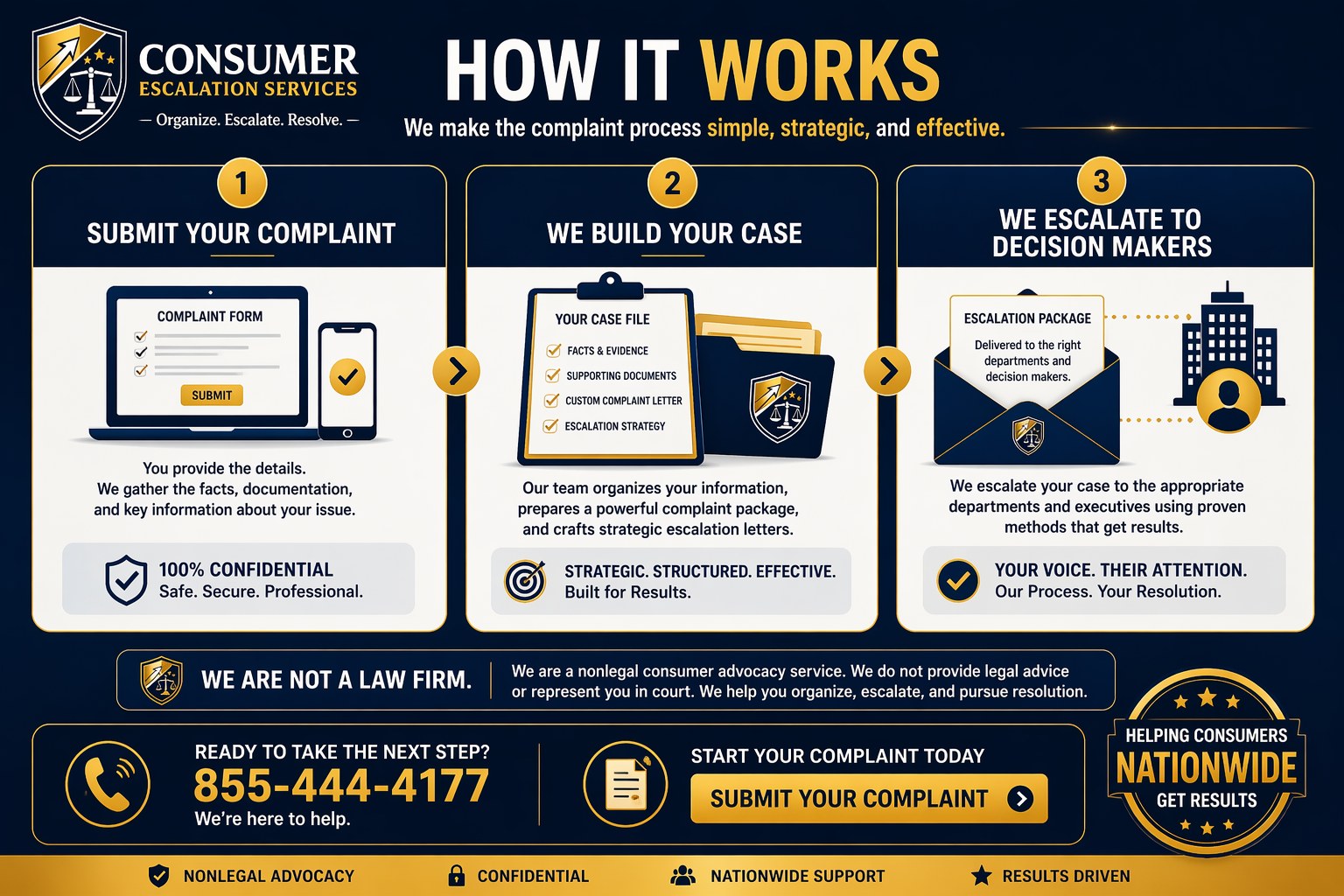
At Consumer Escalation Services, we help consumers organize complaints, prepare professional documentation, and escalate unresolved issues through structured, nonlegal consumer advocacy support.
Call 1 (855) 444-4177 or visit ConsumerEscalationServices.com to request help with your complaint.
Definition
What Does It Mean to Escalate a Consumer Complaint?
Escalating a consumer complaint means moving the issue beyond basic customer service and asking for a higher level review.
This may involve contacting a supervisor, executive office, corporate support department, complaint department, billing department, refund review team, regulatory complaint channel, public complaint portal, or other available escalation pathway.
The goal is to move your complaint from a general response queue into a more serious review process.
A professional escalation usually includes:
- A clear explanation of what happened
- A timeline of events
- Copies of receipts, contracts, invoices, emails, screenshots, photos, or other records
- A specific explanation of what resolution you are requesting
- A respectful but firm tone
- Proper follow up
- Documentation of every response
Why complaints fail
Why Many Consumer Complaints Fail
Many consumer complaints fail because they are too emotional, too long, too vague, or missing important documentation.
Common mistakes include:
- Sending angry messages without a clear request
- Calling repeatedly without documenting what was said
- Failing to save emails, receipts, screenshots, or chat transcripts
- Not creating a timeline of events
- Asking for a refund without explaining why
- Contacting the wrong department
- Giving up after one denial
- Making threats that weaken credibility
- Not knowing when to escalate beyond customer service
A company is more likely to take your complaint seriously when your facts are organized and your request is clear.
Step by step
How to Escalate a Consumer Complaint Professionally
Gather Your Evidence
Before escalating, collect everything connected to the complaint. This may include:
- Receipts
- Invoices
- Contracts
- Order confirmations
- Cancellation notices
- Photos
- Screenshots
- Emails
- Text messages
- Chat transcripts
- Names of representatives
- Dates and times of phone calls
- Case numbers or claim numbers
Do not rely only on memory. Documentation matters.
Create a Timeline
A timeline helps the company understand what happened in chronological order. Your timeline should include:
- Date of purchase or service
- Date the problem occurred
- Date you first contacted the company
- Who you spoke with
- What they promised
- What was not resolved
- Every follow up attempt
A strong timeline makes your complaint easier to review.
State the Problem Clearly
Keep your complaint focused. Instead of writing a long emotional message, explain the problem in simple terms.
Clear communication is stronger than frustration.
Explain the Resolution You Want
Do not make the company guess what you want. Be specific. Possible resolutions may include:
- Refund
- Replacement
- Billing correction
- Account credit
- Cancellation confirmation
- Written explanation
- Reimbursement
- Repair
- Escalated review
A clear request helps move the complaint forward.
Use a Professional Tone
Your tone matters. You can be firm without being hostile. A professional complaint should be:
- Respectful
- Direct
- Organized
- Fact based
- Specific
- Calm
- Persistent
Avoid insults, threats, exaggerations, and emotional language that distracts from the facts.
Ask for Escalation in Writing
Whenever possible, ask for escalation in writing.
Written requests create a record and reduce confusion.
Follow Up Properly
If you do not receive a response, follow up professionally. A proper follow up should include:
- Your original complaint date
- Your case number if available
- A short summary of the issue
- A reminder of the requested resolution
- A request for written response
Do not send repeated emotional messages. Send organized follow ups.
When to reach out
When Should You Get Help With a Consumer Complaint?
You may want professional support if:
- The company is ignoring you
- You have been denied without a clear explanation
- You are being passed between departments
- Your complaint involves money, travel, billing, refunds, services, or contracts
- You are not sure how to organize your documents
- You need a professional complaint letter
- You need an escalation package prepared
- You want help presenting your complaint clearly
Consumer Escalation Services helps consumers bring structure and professionalism to unresolved complaints.
Our support
How Consumer Escalation Services Can Help
Consumer Escalation Services provides nonlegal complaint support services. Depending on your situation, we may help with:
- Complaint review
- Timeline organization
- Evidence organization
- Complaint letter drafting
- Executive escalation letters
- Refund dispute support
- Billing dispute support
- Travel complaint support
- Consumer dispute documentation
- Complaint package preparation
- Follow up communication support
We help you organize the facts, prepare stronger documentation, and present your complaint in a more professional way.
FAQ
Frequently Asked Questions
Keep Reading
Related Consumer Resources
More guidance to help you organize, escalate, and resolve consumer complaints.
Billing Dispute Complaint Help
Read guide
Refund Dispute Support Service
Read guide
How to Write a Strong Complaint Letter
Read guide
General Contractor Disputes
Read guide
How to Dispute a Medical Bill Sent to Collections
Read guide
Rideshare and Delivery App Deactivation Complaints
Read guide
Consumer Complaint Help Center
Read guide
Consumer Escalation Services is not a law firm, does not provide legal advice, does not represent clients in court, and does not guarantee outcomes, refunds, reimbursements, settlements, or resolutions. Services are for educational, organizational, documentation, and nonlegal consumer advocacy support purposes only.