Consumer Escalation Services | Nonlegal Complaint Help for Consumers and Small Businesses
We Help Consumers and Small Businesses Organize Disputes, Prepare Complaint Packages, and Escalate Unresolved Issues Professionally
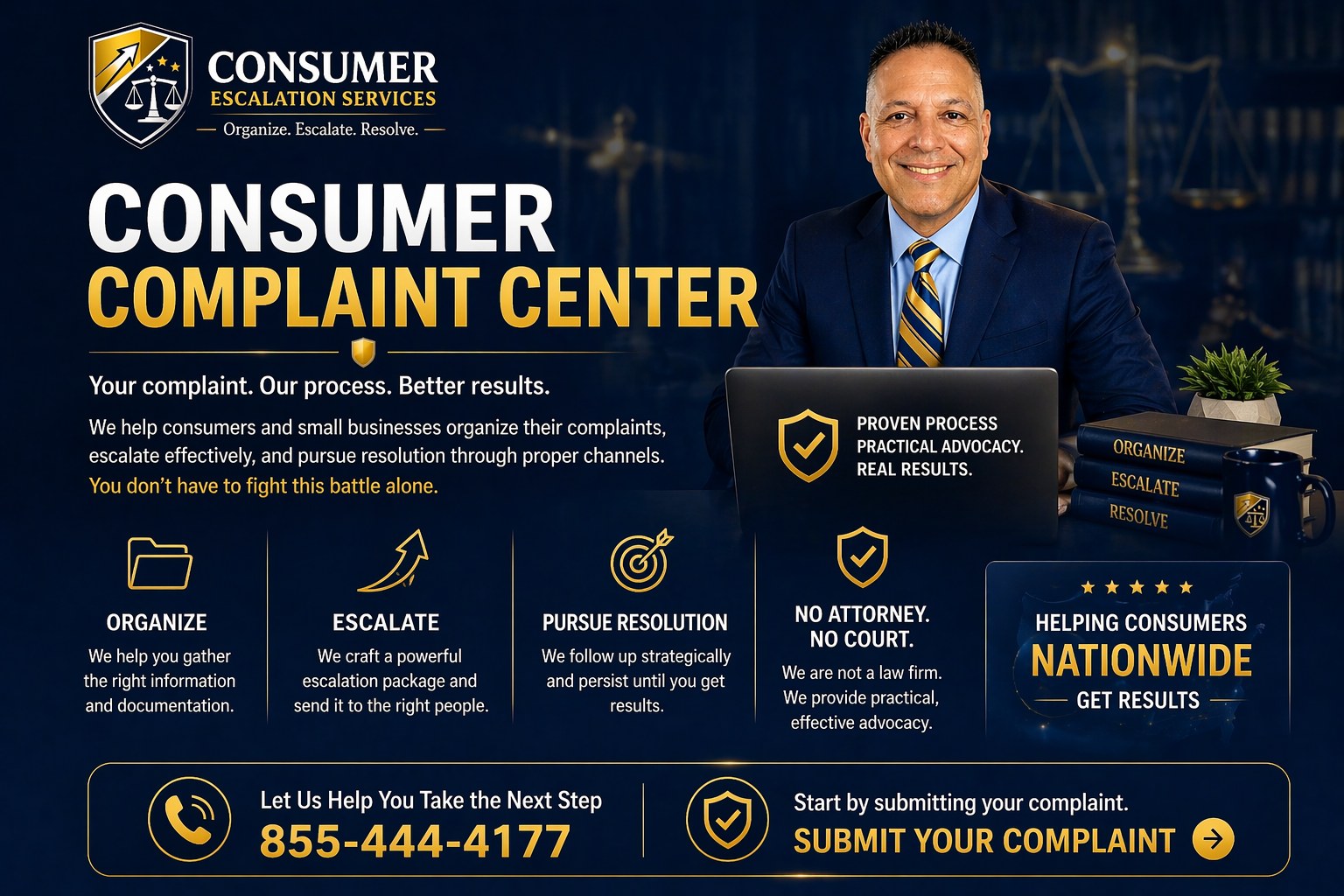
Important: We are not a law firm. We provide nonlegal consumer support, education, and complaint organization guidance only.
Our Services
- Free Initial Review - $0 - Submit your issue for an initial review, service-fit check, and recommended next step
- Simple Escalation Letter - $69 - A professional nonlegal escalation letter for refund, billing, cancellation, subscription, and merchant complaints
- Standard Escalation Package - $129 - Customized escalation letter, timeline, evidence checklist, and follow-up template
- Executive Escalation Package - $179 - Executive-level nonlegal escalation package for serious complaints where standard customer service has failed
- Medical Bill Dispute Support - $199 flat rate - Nonlegal document organization for medical bill and collections disputes
- Rideshare App Deactivation Support - $179 - Focused appeal and escalation materials for Uber and Lyft drivers
- Delivery App Deactivation Support - $179 - Focused appeal and escalation materials for DoorDash, Uber Eats, Instacart, Amazon Flex, and Grubhub drivers
- CES Consumer Protection Membership - $99/year - Optional annual membership for ongoing nonlegal consumer complaint support
CES pricing is straightforward, with no hidden fees or ongoing monthly costs. Clients pay upfront when submitting the intake form. Payment is for the preparation, review, organization, and writing work performed. CES does not offer a general money-back guarantee and does not guarantee any outcome.
Who We Help
CES helps consumers and small business owners nationwide with:
- Refund disputes and refund denials
- Billing, subscription, and cancellation issues
- Merchant complaints and customer service failures
- Chatbot loops, AI customer service denials, and automated refund rejections
- Marketplace account holds and payment app freezes
- Rideshare and delivery app deactivations (Uber, Lyft, DoorDash, Uber Eats, Instacart, Amazon Flex, Grubhub)
- Medical billing disputes and medical collections
- Contractor and home repair disputes
- Security deposit and landlord/tenant disputes
- Credit card charge and chargeback disputes
- Travel and airline complaints
- Auto repair shop and warranty complaints
- Small claims documentation preparation
- Executive escalation situations
Common matters include billing disputes, refund issues, chatbot loops, AI-driven denials, account freezes, app deactivations, medical billing, contractor disputes, and small claims documentation preparation.
Contact Us
Phone: 1 (855) 444-4177
Email: support@consumerescalationservices.com
Service Area: Entire United States (Nationwide)
24-Hour Response to all inquiries
Service Disclosure
Consumer Escalation Services is a nonlegal consumer support and education business. We are not a law firm and do not provide legal advice, legal representation, financial advice, insurance adjusting, debt settlement, or regulated professional services unless expressly stated in writing. We do not guarantee refunds, reinstatements, compensation, responses, or any specific outcome.
Legal Disclaimer Summary
This summary applies to all pages of consumerescalationservices.com, including /disclaimer, and is provided for non-JavaScript visitors and compliance audit tools. The full Legal Disclaimer page is available at /disclaimer when JavaScript is enabled.
- Consumer Escalation Services is not a law firm.
- CES does not provide legal advice or legal representation.
- No attorney-client relationship is created by visiting this website, submitting an intake form, purchasing a service, using the Ask Atlas assistant, communicating with CES, or receiving materials from CES.
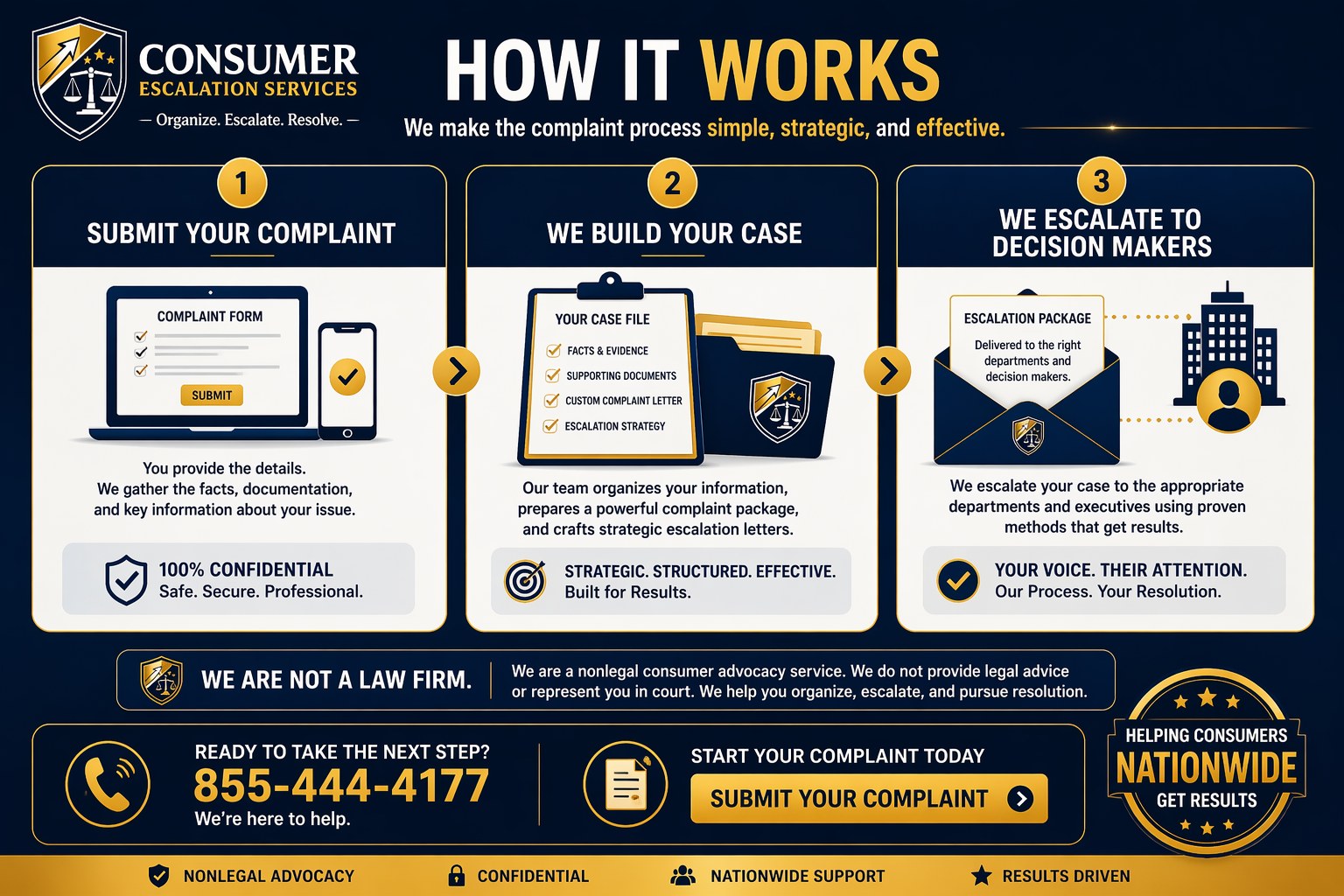
- CES provides nonlegal consumer complaint organization, document organization, timeline preparation, evidence indexing, complaint letter support, and escalation package preparation only.
- CES does not prepare court filings, arbitration filings, pleadings, legal motions, or legal claims, and does not interpret laws, contracts, or platform agreements as legal advice.
- CES does not guarantee refunds, reinstatements, compensation, company responses, account reactivation, corrected bills, dispute resolution, or any specific outcome. CES does not offer a general money-back guarantee.
- Clients review, approve, sign where applicable, and send materials in their own name unless a separate authorized nonlegal sending process is created later.
- Consumers with legal questions, lawsuits, arbitration matters, legal deadlines, legal claims, or questions about legal rights should consult a licensed attorney.
Contact: Consumer Escalation Services, ConsumerEscalationServices.com, support@consumerescalationservices.com, 1 (855) 444-4177.