Consumer Escalation Services logo

Refund Disputes

Refund Dispute Warning Signs

Six early signals that a refund dispute is stalling on purpose — and how to recognize them before the matter quietly gets written off.

Refund dispute warning signs — recognizing when a refund issue requires stronger documentation and escalation
Estimated read time: 5 minutesLast updated: April 30, 2026

A refund dispute rarely starts as a fight. It usually starts with a polite request, an apology from a support agent, and a promise that someone will look into it. The trouble shows up later — in the gaps between messages, in the answers that keep changing, in the ticket that gets quietly closed. By the time it feels like a real problem, weeks may have already passed.

Refund disputes are often resolvable. The harder ones tend to share a few early patterns that, if recognized in time, change how a consumer responds.

Why Refund Disputes Often Stall

Refunds touch finance teams, processors, vendors, and back-office reconciliation systems that most front-line agents do not control. Even when an agent agrees that a refund is owed, the actual issuance can sit in a queue for days or weeks. Some companies allow that delay to become a stalling pattern. Other times, the file simply moves between teams until the consumer gives up.

The warning signs below are not accusations. They are signals that a refund matter may need to be reorganized and escalated rather than passively followed up on.

Sign 1 — The Company Keeps Asking for the Same Information

Sending the same order number, transaction ID, or receipt for a third or fourth time is a meaningful signal. It usually means the matter is being passed between agents who do not have visibility into the prior conversation, or that the file has not been escalated to anyone who can actually issue a refund. The longer this pattern continues, the more value there is in consolidating everything into a single written summary you control.

Sign 2 — Customer Service Gives Vague or Changing Answers

When the explanation shifts — first the refund is "processing", then it is "under review", then it is "denied per policy" — the underlying decision usually has not been made. Vague language is often a holding pattern. Consumers who notice this early start asking for written, specific responses instead of accepting general reassurance.

Sign 3 — A Refund Is Promised With No Timeline

"You should see it soon" is not a timeline. Neither is "in the next few business days" repeated four times. A real refund has a date attached to it. When a company will not commit to a date in writing, the matter is functionally still unresolved — even if it sounds like progress.

Sign 4 — Your Complaint Keeps Getting Closed Without Resolution

Tickets that close automatically, get marked "resolved" without contact, or are quietly merged into other tickets are a strong signal that the dispute is moving sideways instead of forward. At this stage, every reopened ticket is a chance to reset the matter with a clear written summary, prior ticket numbers, and a specific requested resolution.

Sign 5 — No One Will Put the Decision in Writing

A phone call that promises a refund and an email that confirms a denial are not the same thing. When a company avoids putting the decision in writing — whether positive or negative — it is usually because the file is unsettled internally. Asking explicitly for a written reply, even a short one, is reasonable and often surfaces what is actually happening behind the scenes.

Sign 6 — The Company Blames Another Department, Vendor, Platform, or Processor

When the merchant points at the payment processor, the processor points at the bank, the bank points at the merchant, and the platform points at the seller — the consumer is the only one without leverage in that loop. The matter does not become solvable again until one party is asked, in writing, to take ownership of the resolution.

What to Document Immediately

  • The original order, receipt, or contract — with the disputed amount clearly identified
  • Every email, chat transcript, and SMS exchange about the refund
  • Names of representatives, ticket numbers, dates, and times of contact
  • Any written statements where the refund was promised or denied
  • Bank or card statements showing the original charge and any partial credits
  • A simple one-page summary of what was paid, what went wrong, and what you are requesting

When to Organize the Dispute Before Escalating

If two or more of the warning signs above apply, the next message you send should not be another follow-up. It should be a reset: a single written summary that consolidates the prior contacts, the timeline, the supporting documents, and the specific resolution you are asking for, with a reasonable response window. Most refund disputes that move forward at this stage do so because the consumer changed the shape of the conversation, not its volume.

Final Takeaway

Refund disputes rarely fail because the consumer is wrong. They fail because the matter never gets organized into something a decision-maker can act on. Recognizing the warning signs early — same questions, vague answers, no timeline, closed tickets, no written confirmation, blame-shifting — is what separates a refund that gets quietly written off from one that actually gets resolved.


Need Help?

If your refund dispute is going in circles

CES helps consumers organize the facts, prepare a structured complaint package, and escalate refund disputes professionally as nonlegal consumer advocacy support.

Keep Reading

More Consumer Insights

Consumer reviewing an under-review complaint message on a phone and laptop for Consumer Escalation Services insight article

Escalation Strategy

When "Under Review" Becomes a Delay Tactic

Read article

Consumer organizing relevant and non-relevant evidence for a complaint with Consumer Escalation Services branding

Documentation

Why Too Much Evidence Can Hurt Your Complaint

Read article

Consumer calmly preparing a professional complaint escalation letter with Consumer Escalation Services branding

Escalation Strategy

How to Escalate a Complaint Without Losing Credibility

Read article

Consumer documenting conflicting customer service answers during a complaint escalation

Customer Service Warning Signs

When Every Customer Service Agent Gives You a Different Answer

Read article

Consumer gathering refund records, receipt, order confirmation, photos, and messages before filing a complaint

Refund Disputes

Before You Demand a Refund, Build the Record

Read article

Consumer Escalation Services article on what to do when a company says final decision

Escalation Strategy

When a Company Says "Final Decision": What Consumers Should Do Next

Read article

Consumer Escalation Services article on the difference between complaining and escalating

Escalation Strategy

The Difference Between Complaining and Escalating

Read article

Consumer Escalation Services article on customer service red flags that signal escalation is needed

Customer Service Warning Signs

Red Flags That Your Customer Service Issue Needs Escalation

Read article

Consumer Escalation Services article on how screenshots can support a consumer complaint

Documentation

Why Screenshots Can Make or Break a Consumer Complaint

Read article

Consumer Escalation Services article on writing a clear, organized consumer complaint

Complaint Letter Writing

How to Write a Complaint That a Company Can Actually Review

Read article

Consumer Escalation Services guide showing documents drivers should save after app deactivation

Rideshare & Delivery App Deactivation

What Documents Drivers Should Save After App Deactivation

Read article

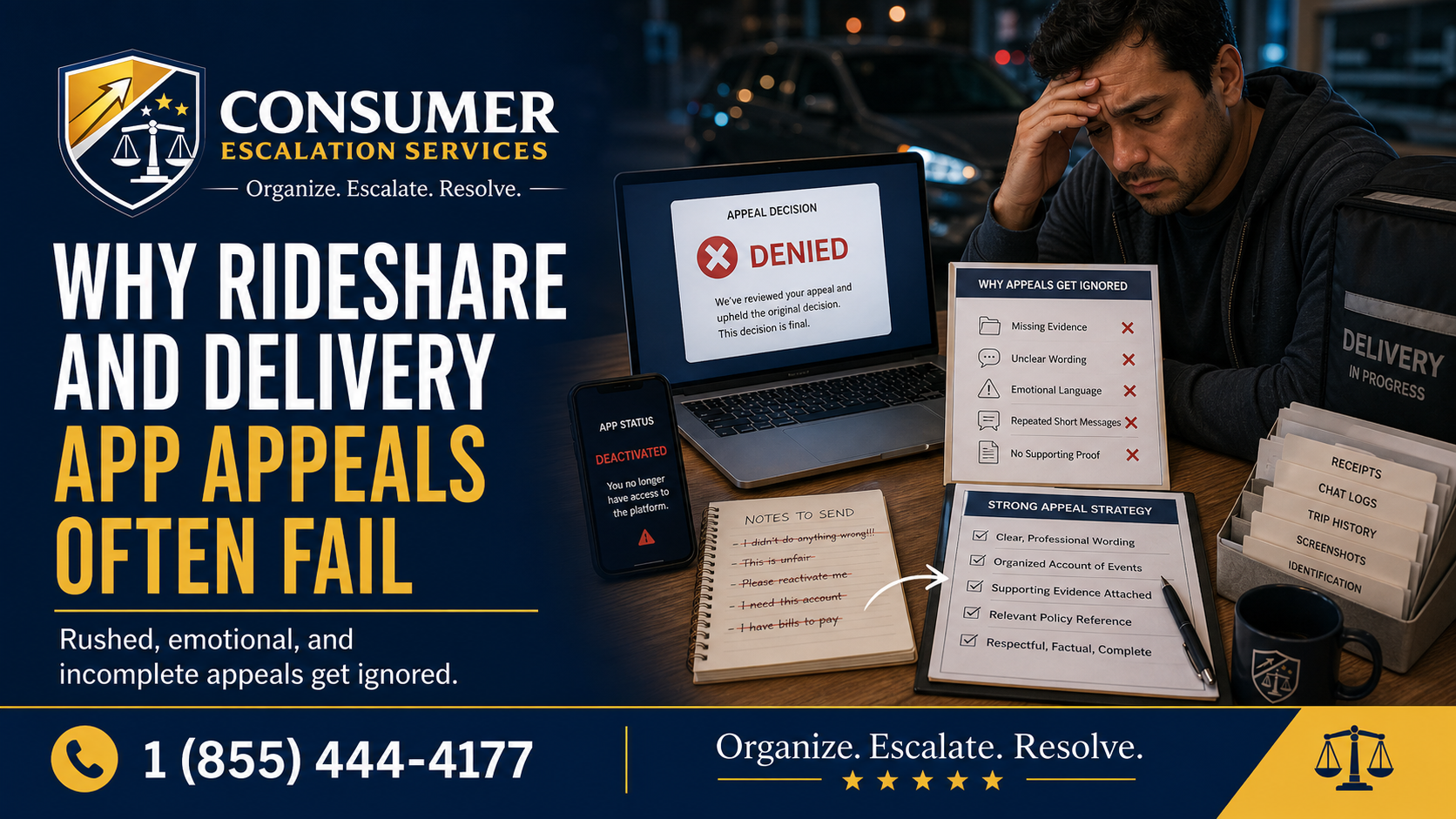
Consumer Escalation Services article explaining why rideshare and delivery app appeals often fail

Rideshare & Delivery App Deactivation

Why Rideshare And Delivery App Appeals Often Fail

Read article

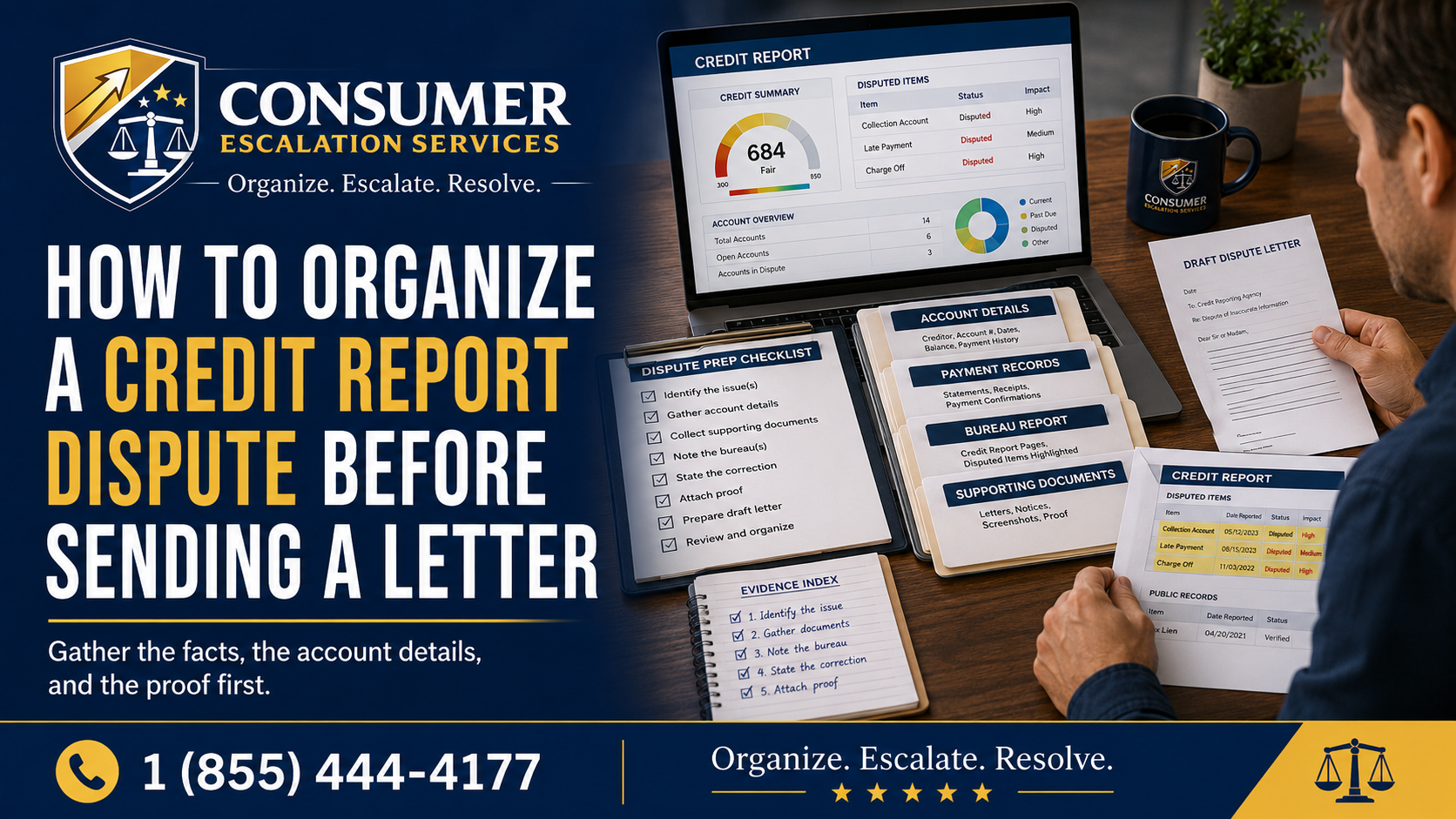
Consumer Escalation Services guide for organizing a credit report dispute before sending a letter

Credit Report Disputes

How To Organize A Credit Report Dispute Before Sending A Letter

Read article

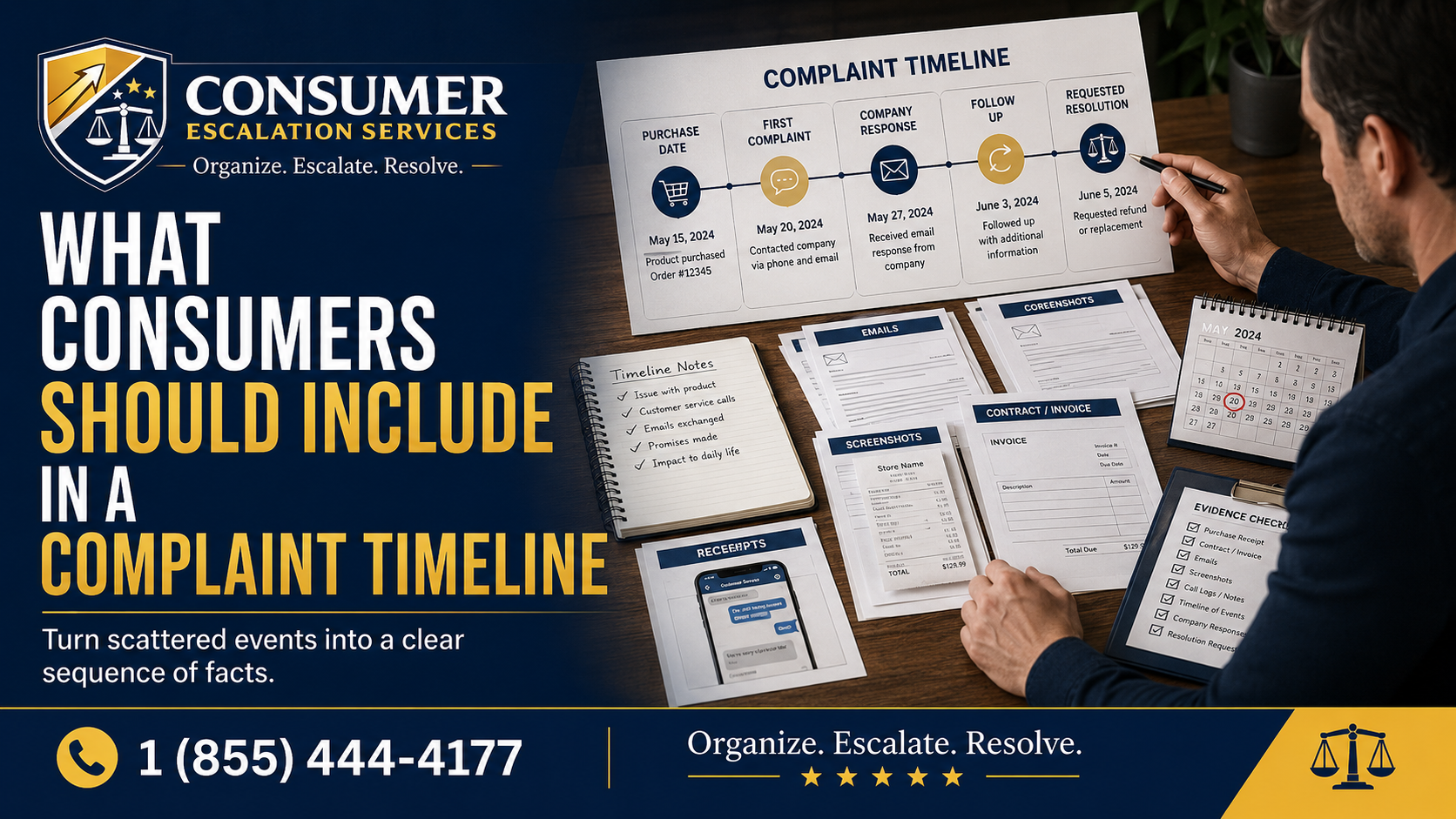
Consumer Escalation Services article showing how to organize a consumer complaint timeline

Complaint Preparation

What Consumers Should Include In A Complaint Timeline

Read article

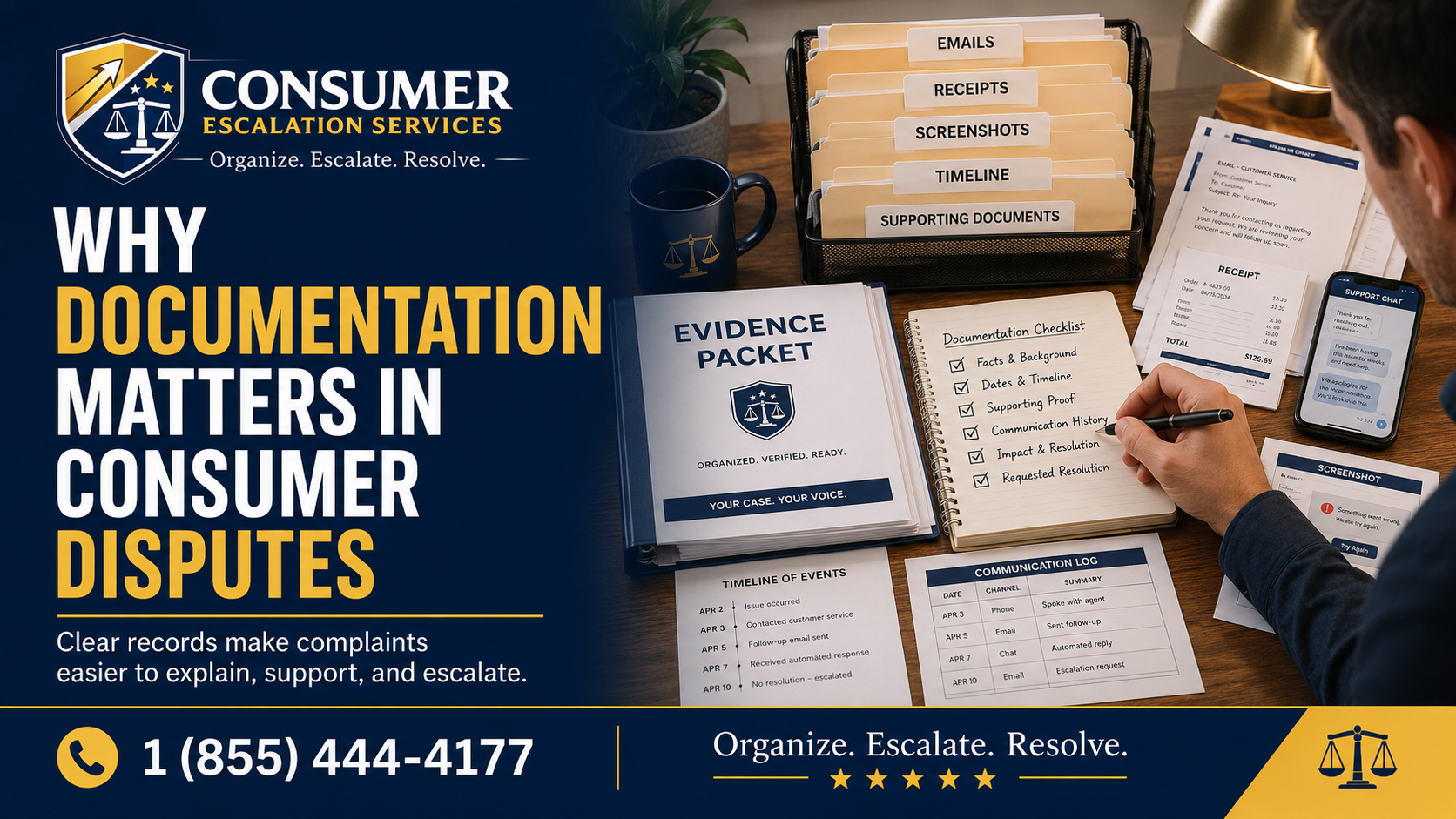
Consumer Escalation Services article about why documentation matters in consumer disputes

Documentation and Evidence

Why Documentation Matters In Consumer Disputes

Read article

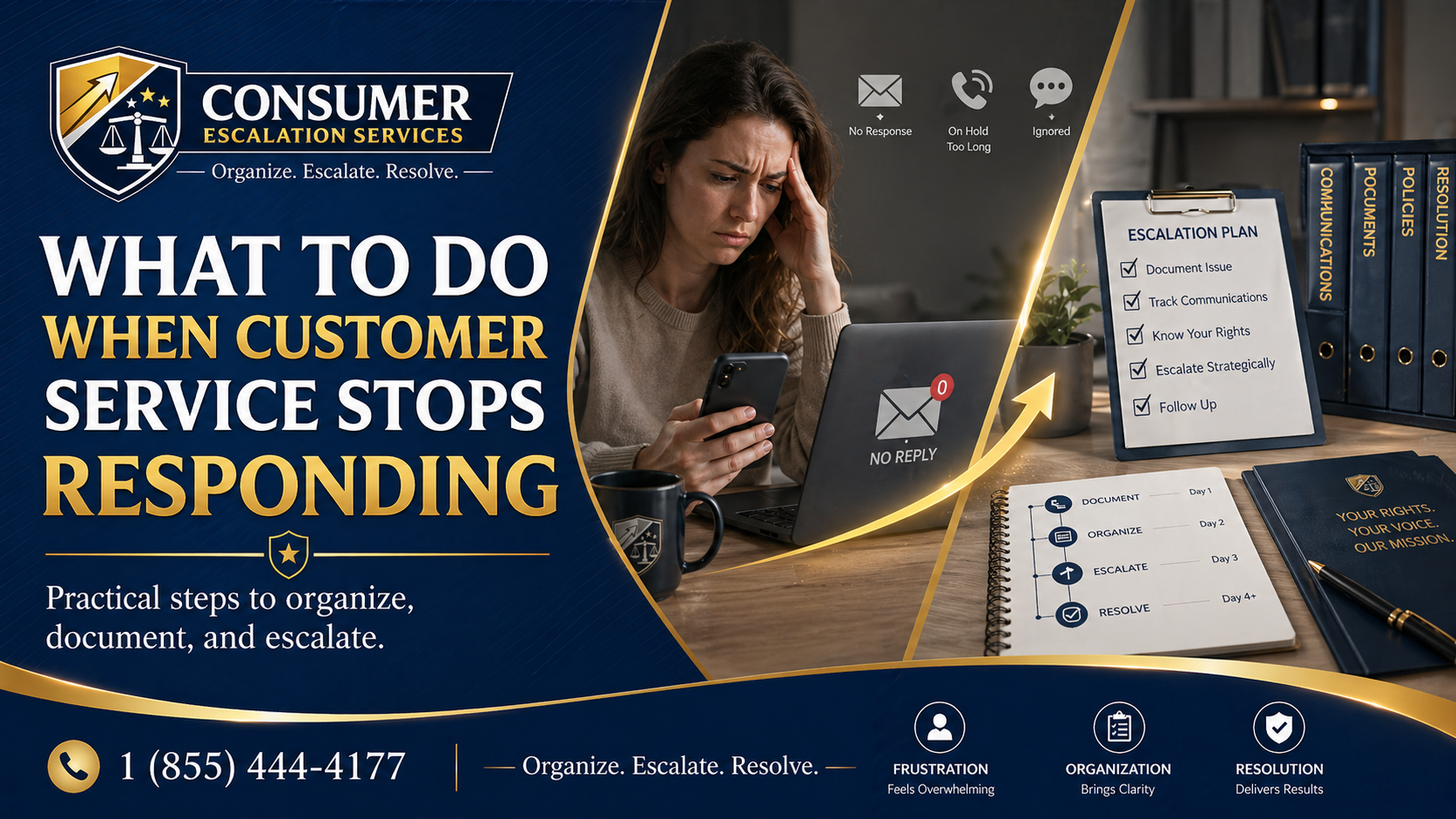
What to do when customer service stops responding — organize, document, and escalate professionally

Customer Service Escalation

What to Do When Customer Service Stops Responding

Read article

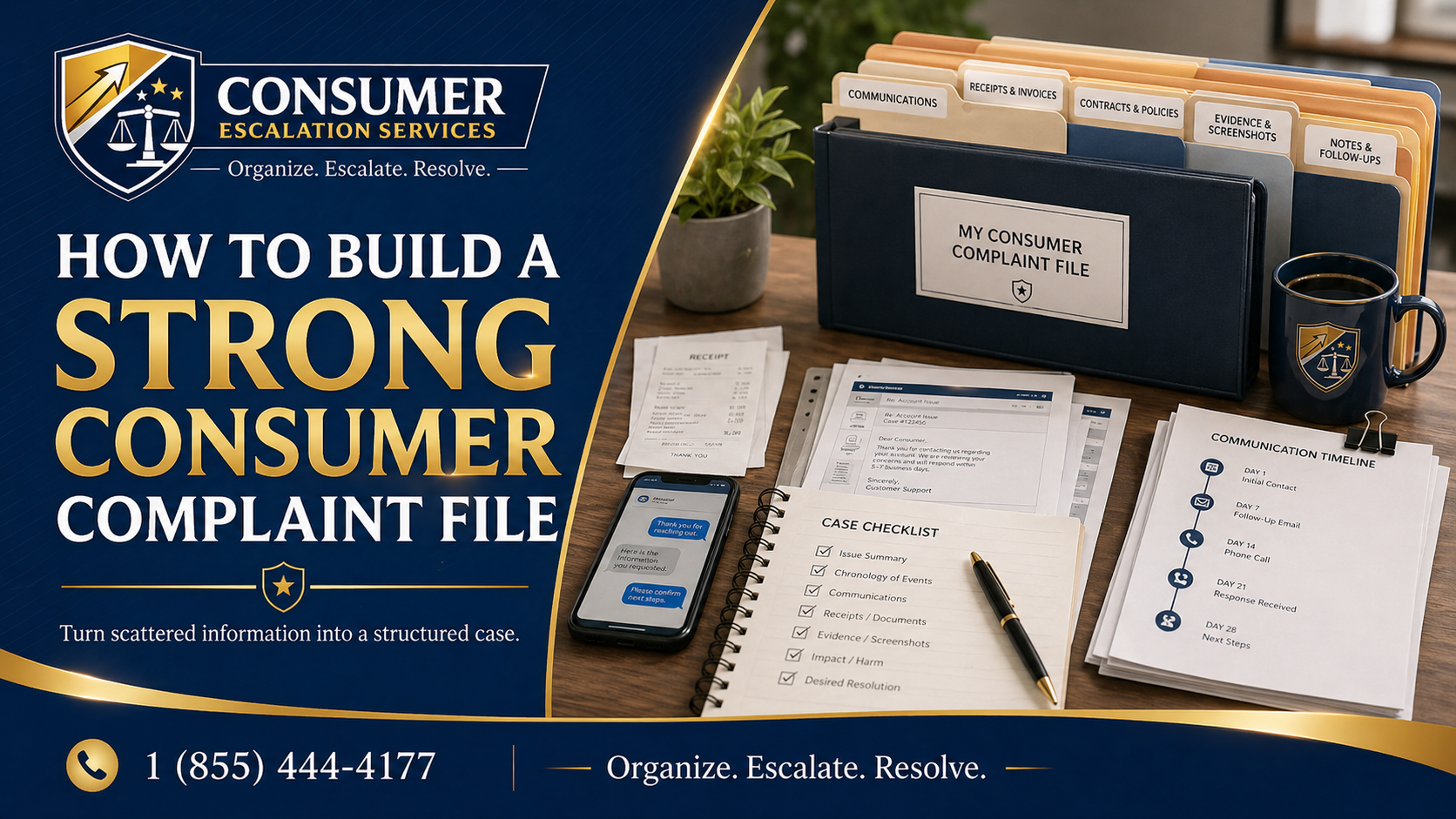
How to build a strong consumer complaint file — timelines, receipts, screenshots, and supporting documents

Complaint Documentation

How to Build a Strong Consumer Complaint File

Read article

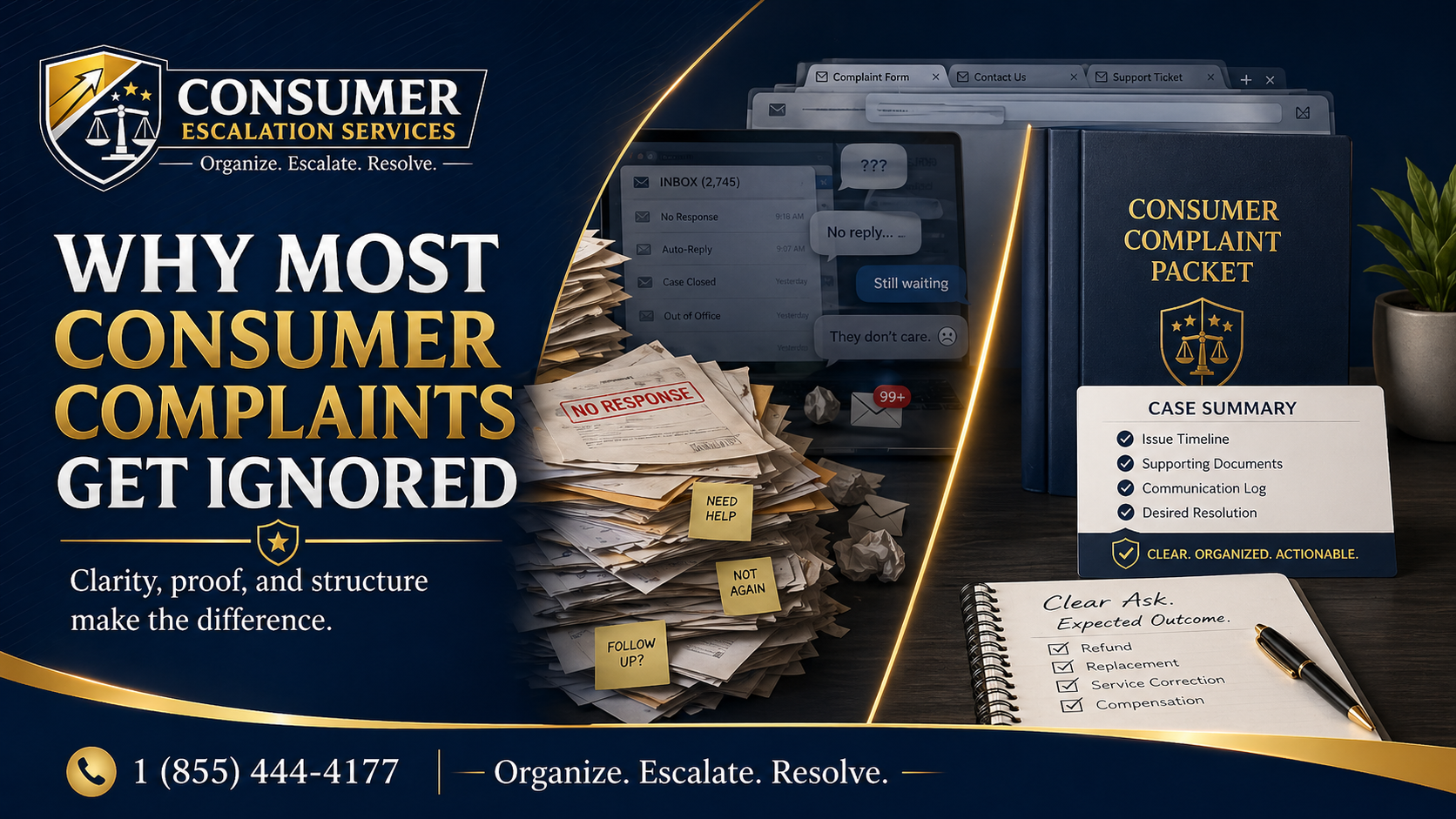
Why most consumer complaints get ignored — clarity, proof, and structure make the difference

Complaint Strategy

Why Most Consumer Complaints Get Ignored

Read article

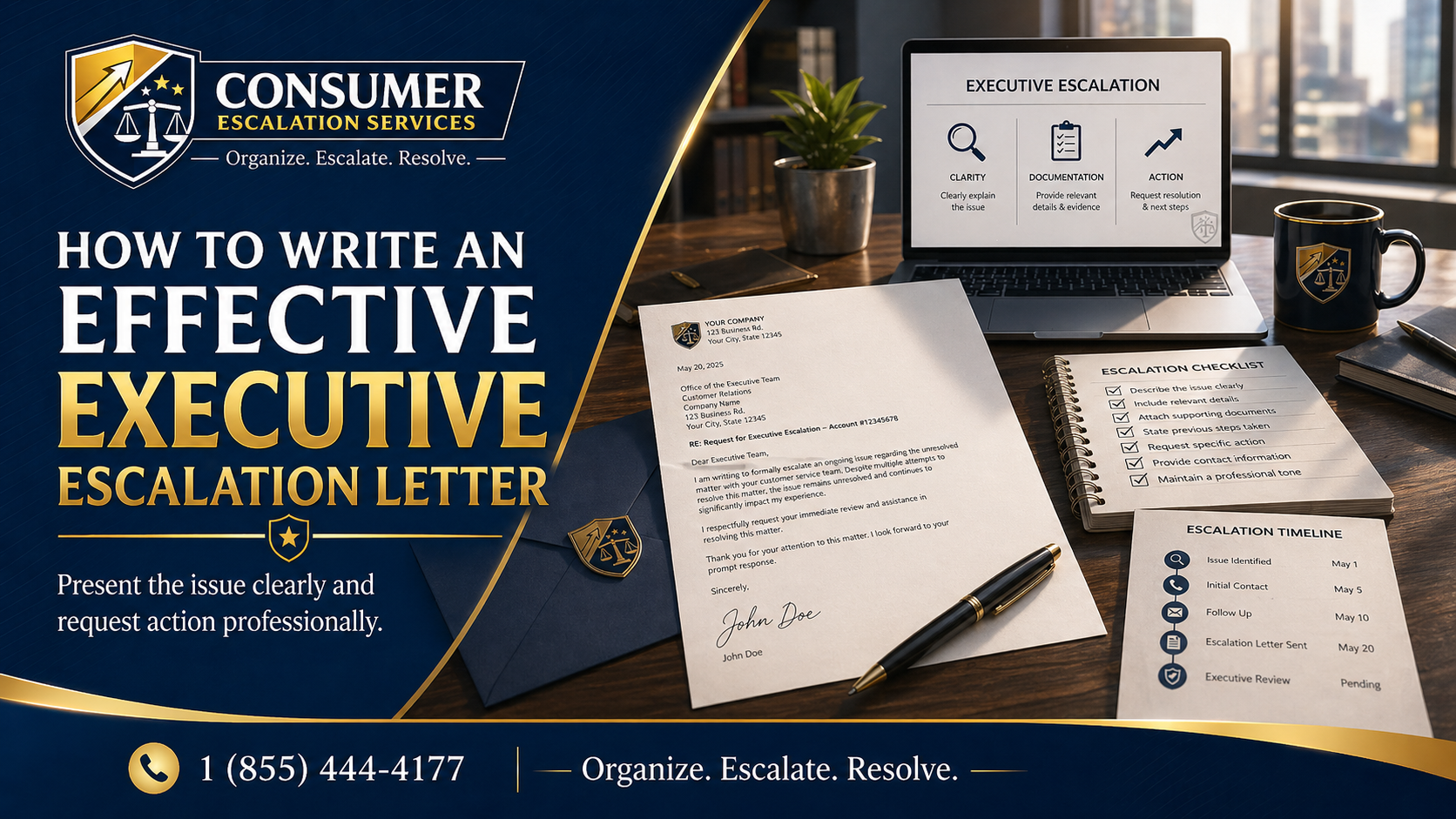
How to write an effective executive escalation letter — present the issue clearly and request action professionally

Executive Escalation

How to Write an Effective Executive Escalation Letter

Read article

Homeowner reviewing unfinished contractor work and preparing a complaint escalation file

Contractor & Home Improvement Disputes

What To Do When a Contractor Does Not Finish the Job

Read article

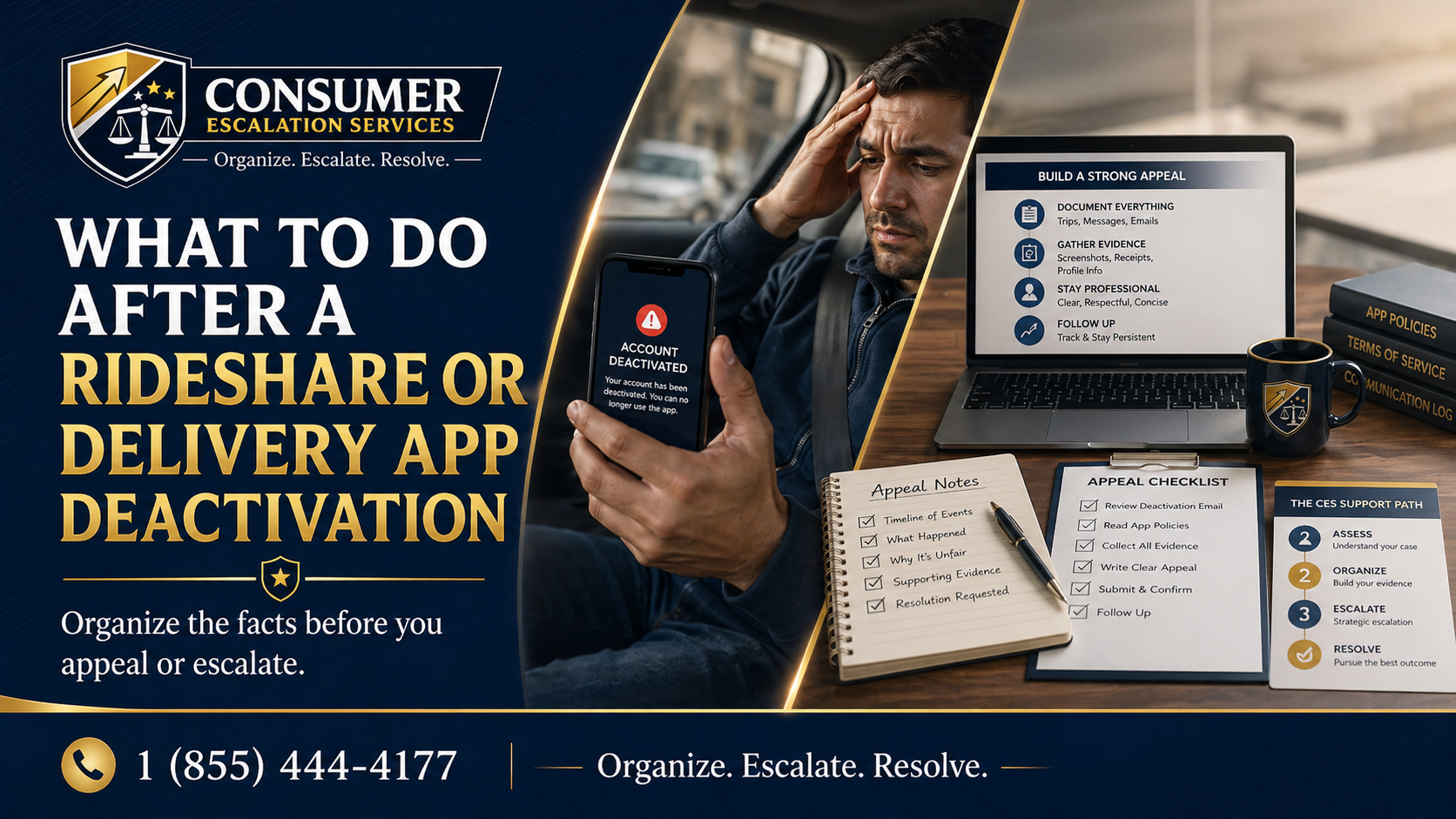
Rideshare and delivery driver reviewing app deactivation notice and organizing appeal documents

Rideshare & Delivery App Deactivation

What To Do After a Rideshare or Delivery App Deactivation

Read article

Escalation before giving up — how to organize, document, and prepare a complaint properly

Escalation Readiness

Escalation Before Giving Up

Read article

Consumer Escalation Services is not a law firm, does not provide legal advice, and does not guarantee any outcome.